


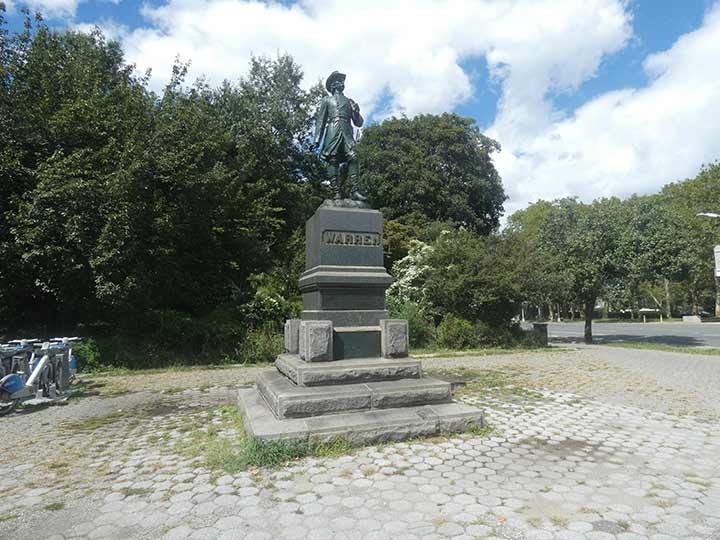
A depiction of General Gouverneur Kemble Warren (1830-1882) can be found at Flatbush Avenue and Union Street. A surveyor and engineer by trade, he arranged a last minute defense at Little Round Top at the Battle of Gettysburg; while he was regarded as an architect of the Northern victory there, he was less successful at the Battle of Five Forks in Virginia and was relieved by General Philip Sheridan.
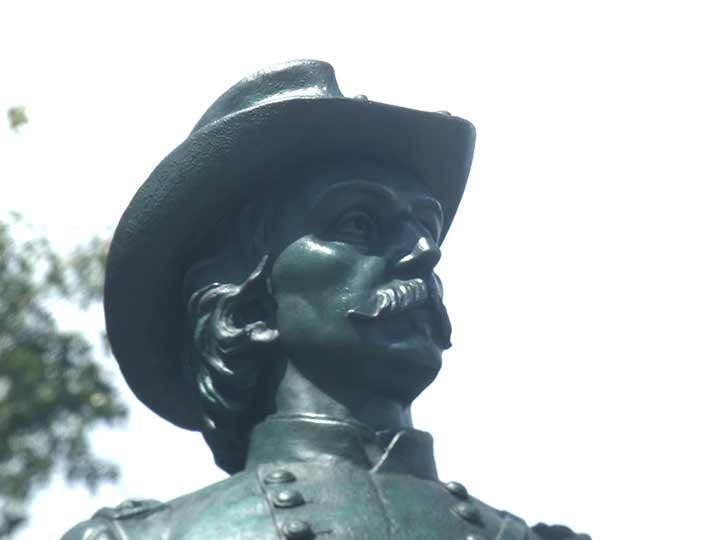
Warren was born in Cold Spring, NY. He remained in the Army after the war, working in surveying and harbor improvements. Another statue of Warren was erected at Round Top at Gettysburg, on the 6th anniversary of his death.
“Rendered here, in a elegant standing portrait by Henry Baerer, Warren’s pedestal includes a slab taken from the very outcrop on which he won his glory, a gesture recalling the granite block that the 14th Regiment brought back from Gettysburg.” — Out of Fire and Valor, Cal Snyder. Baerer’s statue was dedicated June 26, 1896.
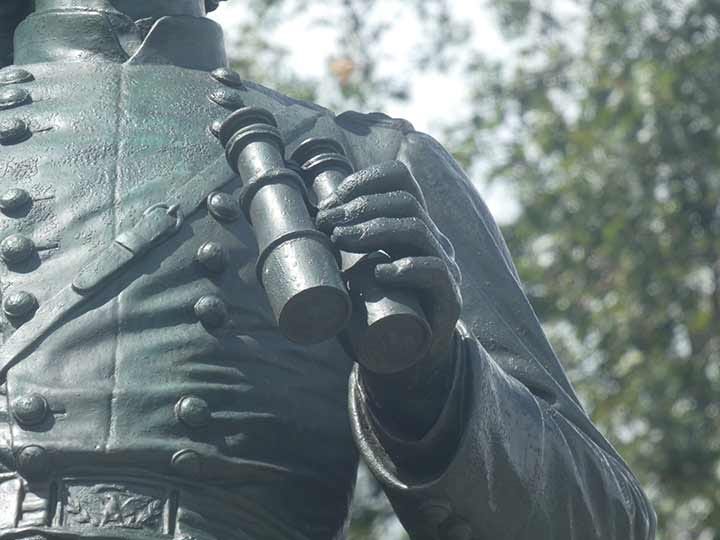
“The statue was a gift of the Warren Post No. 286 of the New York Department of the Grand Army of the Republic, the grass-roots veterans organization, as part of a concerted effort to rehabilitate Warren’s image, which took a beating during the latter stages of the war. In short, the controversy began at Five Forks, during the final weeks of the war. Warren’s troops are roundly regarded as having clinched the Union victory there, but his commanding officer, Gen. Philip Sheridan, thought Warren acted too slow and relieved him. The overall Union commander, Gen. Ulysses Grant, apparently took Sheridan’s side, stonewalling Warren’s efforts to restore his reputation even when Grant was president. Warren was eventually exonerated by a court of inquiry, though; unfortunately for Warren, the judgment was reached about six months after he died.”— New York City Statues
There is a Warren Street in nearby Cobble Hill and Park Slope, but to me it’s uncertain whether it was named for the general.
More on statuary surrounding Prospect Park here.
Kevin Walsh is the webmaster of the award-winning website Forgotten NY, and the author of the books Forgotten New York (HarperCollins, 2006) and also, with the Greater Astoria Historical Society, Forgotten Queens (Arcadia, 2013).