
The Lost Railroad


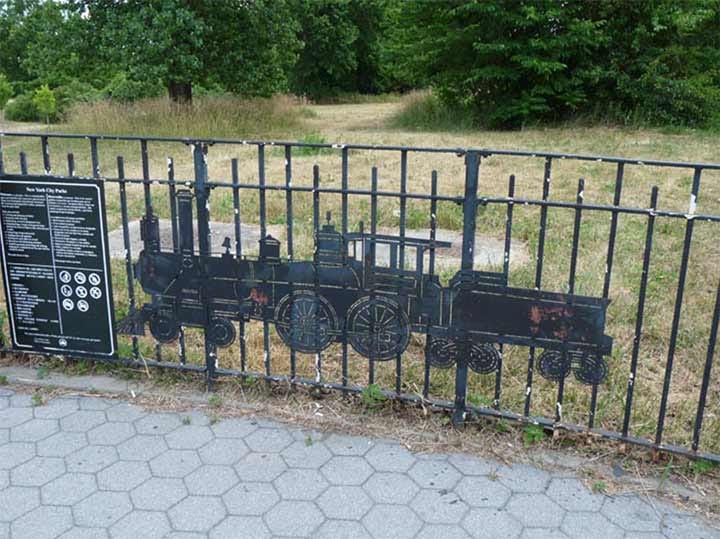
Why is there a wrought-iron rendering of a locomotive on the Kissena Park fence at Kissena Boulevard and Rose Avenue in Flushing? There’s a reason it’s there.
A lengthy gash of green known as the Kissena Corridor can be seen on Queens maps, running from Flushing Meadows-Corona Park at its western end all the way east to Cunningham Park at Francis Lewis Boulevard on the east. The Queens Botanical Garden between College Point Boulevard and Main Street forms its western end, while a narrow patch is slotted between Colden Street and 56th Avenue/56th Road.
The gash “widens” into Kissena Park proper, which is divided into a “parklike” northern section and a more “natural” southern section, between Kissena Boulevard, Rose Avenue, Oak Avenue, Booth Memorial Avenue and 164th Street. East of that, the Kissena Corridor’s narrowest sector runs from Fresh Meadow Lane to the Long Island Expressway, after several blocks’ interruption by the Kissena Golf Course between 164th and Fresh Meadow Lane.
The Kissena Corridor is there because it is the ancient right-of-way for a long-vanished railroad. In the early 1870s, Scottish immigrant and department store magnate Alexander T. Stewart purchased plots of land from local farmers and built the Central Railroad of Long Island as a means to connect western Queens with a new development of his, Garden City.
The railroad was a financial failure and survived for just a few years, yet the railroad, built over 140 years ago, still survives…after a fashion… as a park, which matches its fate with that of the High Line on the west side of Manhattan.
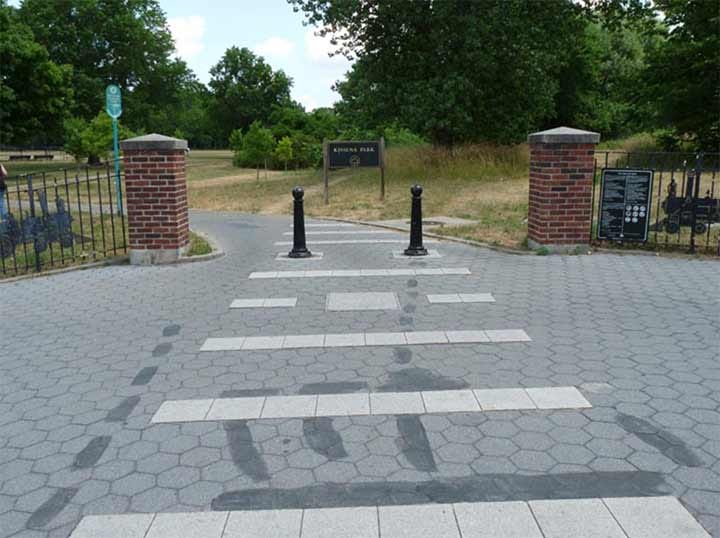
Just as we’re speculating about what would happen if the Long Island Rail Road Bay Ridge freight line through the heart of Brooklyn and into Ridgewood, Queens, could be fitted for mass transit as the Interborough Express, or perhaps the old Ozone Park to Rockaways LIRR branch, abandoned since 1962, could be used again for rail, it’s fun to speculate what would have occurred if Stewart’s line was a success. It would mean a direct connection from the LIRR Port Washington Branch to Garden City, serving the Queens communities of Fresh Meadows, Hollis Hills, Bellerose and Floral Park; the street grid in those areas, after over 140 years, still allows for a a railroad right-of-way!
Read much more on the Central Railroad of Long Island here at Art Huneke’s Arrchives.
Meanwhile, here’s more on Kissena Boulevard.
Kevin Walsh is the webmaster of the award-winning website Forgotten NY, and the author of the books Forgotten New York (HarperCollins, 2006) and also, with the Greater Astoria Historical Society, Forgotten Queens (Arcadia, 2013)
Wow. That’s a new one on me. Thanks.