
Pretty Maiden


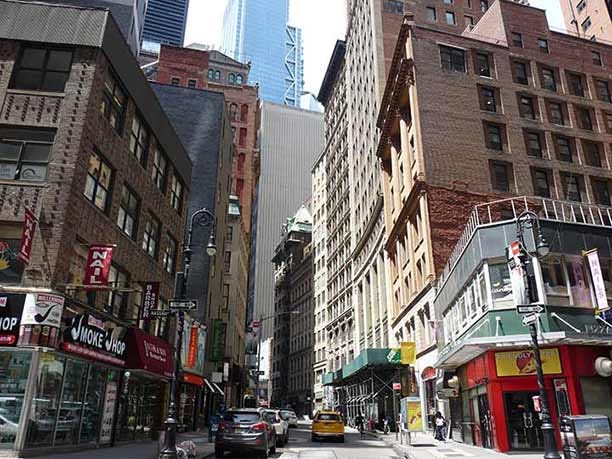
Maiden Lane is one of the oldest routes in Manhattan, following a curved path from Broadway at Cortlandt Street east to South Street. Maiden Lane looking west from Nassau Street. Note how #15 Maiden Lane, center right, has a gently curving facade to conform with the street bend. It is home to New York Legislative Service, Inc., “established in 1932 as the only research group to exclusively focus on the legislative intent and purpose of historical and current legislation of New York State. “
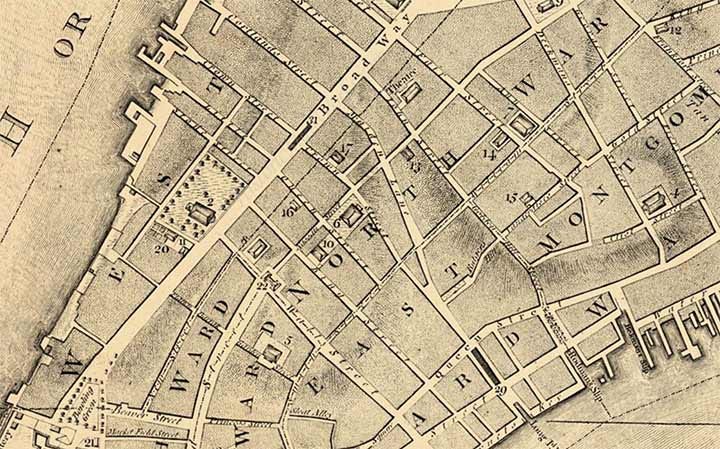
While many streets in lower Manhattan have changed their names since this map was produced in 1776, the Maiden Lane name has stuck. After the British evacuated in 1783, plenty of streets associated with Royal rule were renamed and thus, Crown Street became Liberty, one Queen Street became Cedar and another one became Pearl, King Street became Pine, and streets like Prince (the downtown Prince) and King George Street are now buried under Brooklyn Bridge ramps. NYC has weeded out most of its odder street names, but Maiden Lane persists.
The story goes that the street received its name because it was built atop a stream, since redirected into the sewer system, in which women washed clothes in the Dutch colonial era, when the path beside it was called Maagde Paetje. That’s the story given in my sources, but I’d have to say that these theories are conjectural, unless there’s an official record somewhere.
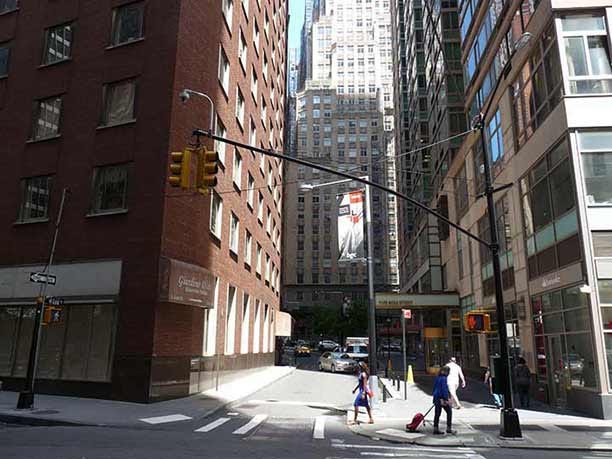
Gold Street, issuing north from Maiden Lane. Gold Street does the Twist as a narrow, curving route north to Fulton, where it gains lanes and becomes a major auto route leading to Madison Street past the Brooklyn Bridge, a gateway to the Lower East Side. It’s just a trickle here, though, and the past few years has been a challenge to photograph as its office buildings are under constant repair and sheds cover the street.
When the Dutch arrived in the early 1600s they found a field in this general area that was filled with yellow celandine flowers, which they called the gouwe and subsequently the new settlement the Gouwenberg. The British, with their penchant for taking Dutch names and re-molding them for English-speaking ears, simply re-named it Golden Hill – which became the site of a battle between the redcoats and patriots in 1770. After a period in which the street was called Rutgers Hill, for patriot and Tammany politician Henry Rutgers (who owned vast land holdings in Manhattan), it eventually reverted to simply Gold Street. Fittingly the Federal Reserve Bank of New York (lots of gold there) is a block away, at 33 Liberty Street.
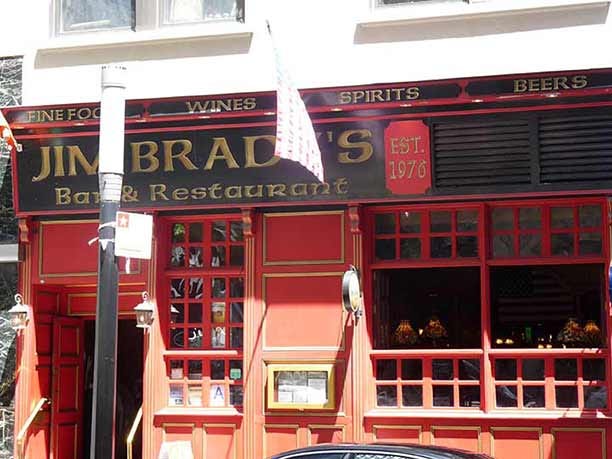
Jim Brady’s, which closed during the Pandemic, was located at #75 Maiden Lane at Nevelson Plaza.
Railroad magnate Jim Brady (1856-1917) was perhaps the world’s greatest gourmand of all time. Brady had made his Gilded Age fortune on railroads, working his way up from bellhop and messenger, but he’s remembered today for his diet. According to legend, a typical Brady breakfast would consist of eggs, pancakes, pork chops, cornbread, fried potatoes, hominy, muffins, and a gallon of orange juice. After a midmorning break with a few dozen clams or oysters, it was time for lunch: two lobsters, deviled crabs, clams, oysters and a few cuts of beef, finishing with several whole fruit pies.
There would be a mid-afternoon snack of shrimp, lobster and lemon soda, followed by visits to restaurants like his favorite, Rector’s on Broadway, where he would settle in for a main course of two whole ducks, several lobsters, another steak, two servings of terrapin, but not before an appetizer of seafood and turtle soup. Dessert included a 2-lb. box of candy. In the course of a day, the voracious entrepreneur would consume members of most major vertebrate classes, the fishes, reptiles, birds and mammals, as well as many invertebrate and plant classes. He seems to have left out the amphibia, though he must have had frogs’ legs somewhere along the way. Brady also owned the first automobile to run on NYC streets in 1895. A feature film on Diamond Jim was made in 1935, with Preston Sturges in the director’s chair and Edward Arnold in the title role (which he reprised in the Lillian Russell biopic by Irving Cummings starring Alice Faye, which followed in 1940). Despite his admiration for singer Lillian Russell, Brady remained a confirmed bachelor his entire life.
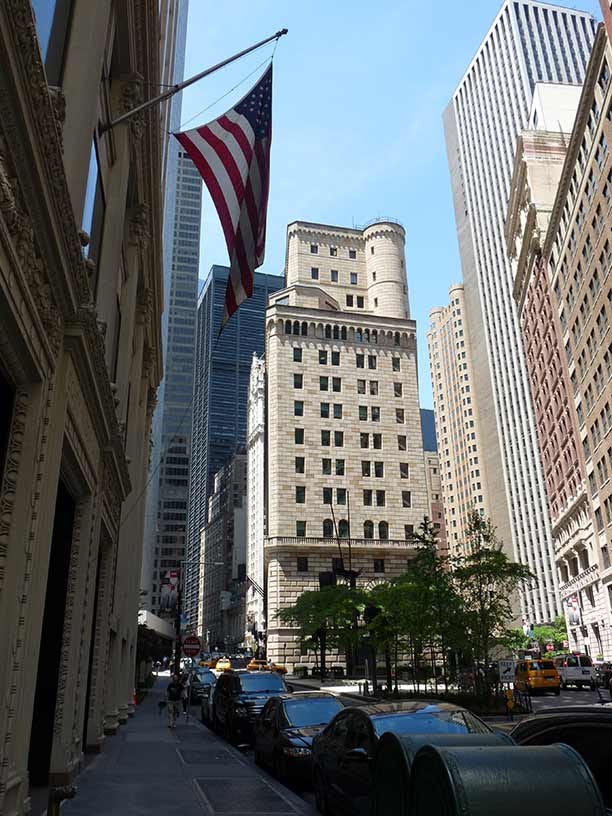
Wedged between Liberty and Nassau Streets and Maiden Lane is the Federal Bank Reserve of NY Building [York & Sawyer, archs], completed in 1924 and consisting of Indiana limestone and Ohio sandstone. Five stories are below street level with subterranean vaults, containing the gold reserves of many nations, resting on bedrock. There is more monetary worth stored here (over $90B) than in Fort Knox, Kentucky. The bank is the foremost in the dozen that make up the Federal Reserve System.
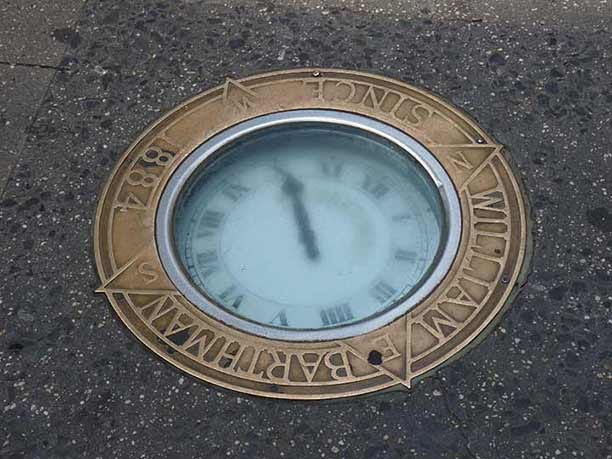
One of Manhattan’s most unique monuments gets stepped on thousands of times daily. William Barthman first set up a jewelry shop in the Financial District in 1884, and added a sidewalk clock on the corner of Broadway and Maiden Lane in 1899. The clock was designed by Barthman and an employee, Frank Homm. When Homm died in 1917, no one knew how to maintain its singular design, and the clock was replaced with a more customary model in 1925 that’s been in place ever since.
The Barthman Clock has been attacked by vandals and trodden on for years, but it keeps on ticking with the help of an electric motor. An organization known as the Maiden Lane Historical Society set up a plaque in 1928 at Barthman’s depicting what Broadway and Maiden Lane looked like that year. In 1946, the NYPD estimated that 51,000 people stepped on the clock every day.
After moving up Broadway a few years ago, the jeweler now has an address in Brooklyn. But it made an arrangement with the current building to maintain the Barthman Clock, even though the unusual timepiece doesn’t have Landmarks Preservation Commission protection. The clock was not telling correct time in July 2022.
#1 Maiden Lane is named for the now-over 125 year old Bathman’s Jewelers. I’m not sure what came first, the jeweler or the building. Since Barthman’s moved out, a junk shop for tourists has moved in.
A complete look at Maiden Lane in Forgotten New York here.
Kevin Walsh is the webmaster of the award-winning website Forgotten NY, and the author of the books Forgotten New York (HarperCollins, 2006) and also, with the Greater Astoria Historical Society, Forgotten Queens (Arcadia, 2013)