


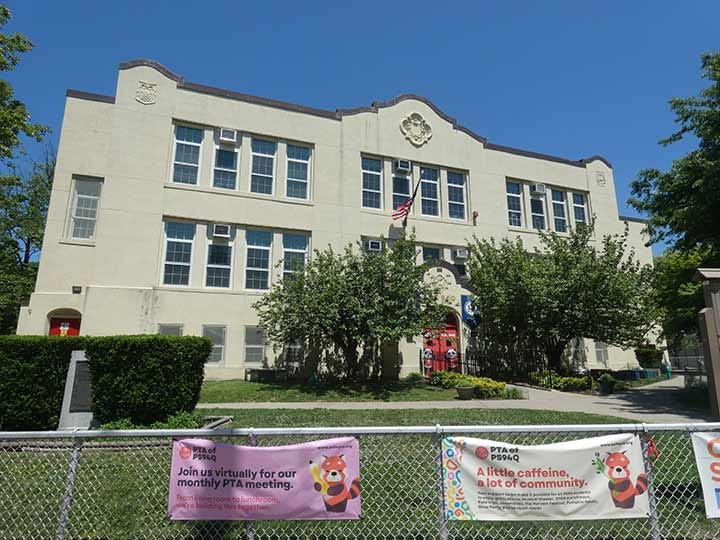
Little Neck boasts a one of a kind public school, at least architecturally, in the Spanish Colonial-tinged PS 94 on Little Neck Parkway and 42nd Avenue down the block from my place. After years of fruitlessly searching for its architect, the AI robot claims it’s C.B. J. Snyder: no surprise there, as he designed dozens of school buildings around town in the early 20th century. Still, I can’t be sure.
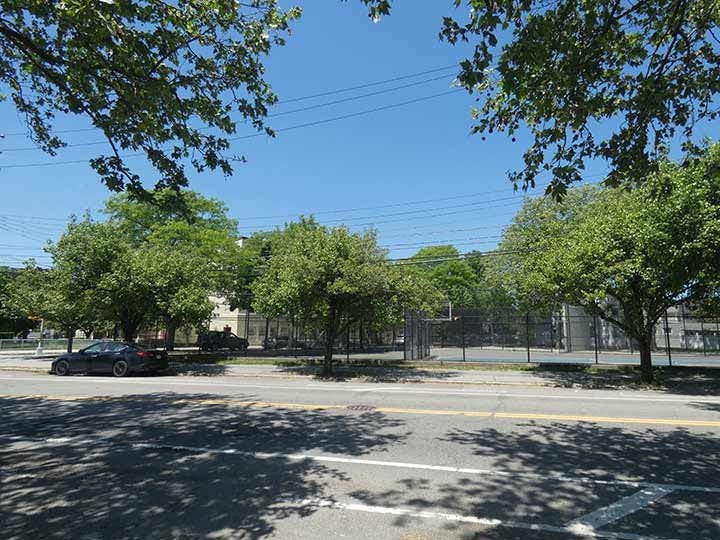
Across 42nd Avenue from the school is a playground with two names. The main gate has a sign naming it Sy Seplowe Playground for a dedicated community activist and youth advocate in northeastern Queens who founded the Little Neck-Douglaston Youth Club in 1953 and was a founding member of Queens Community Board 11. Additionally, he organized the local Memorial Day Parade, served as Little League administrator for School District 26 for 35 years, and led the Little Neck-Douglaston Community Council.
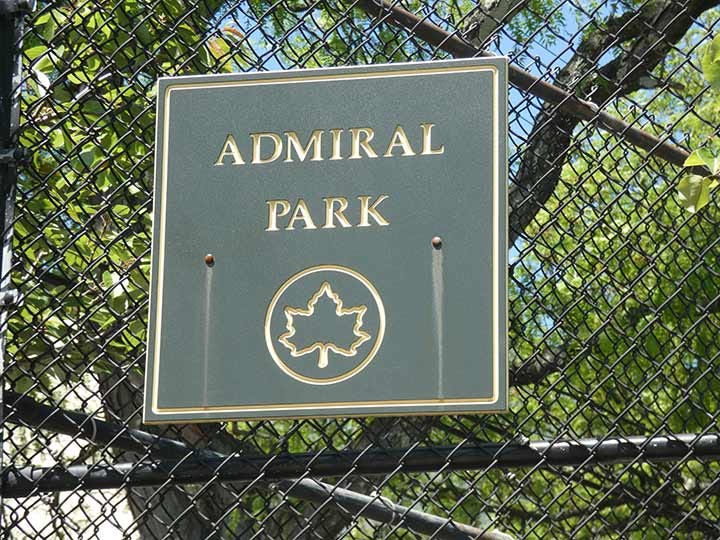
Yet, a second sign on the 42nd Avenue end calls it “Admiral Park,” a moniker it gained in 1985. But who was the admiral?
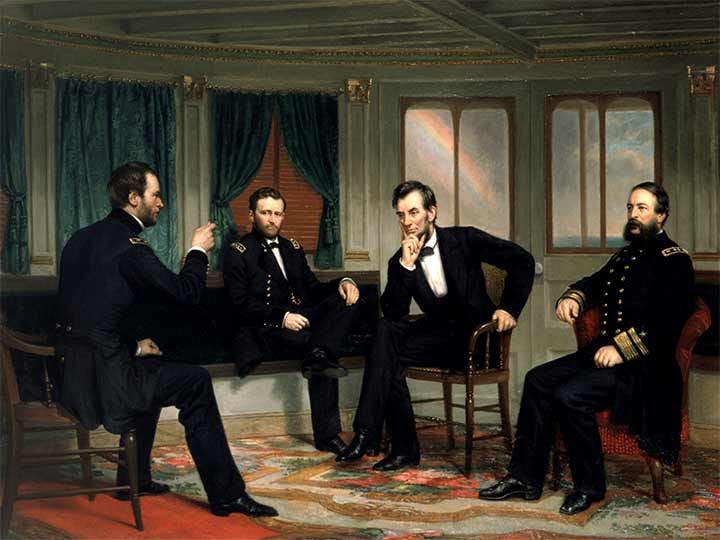
The admiral was David Dixon Porter (1813-1891), seen here on the right in George Peter Alexander Healy’s famed painting The Peacemakers, depicting General William Sherman, General Ulysses S. Grant, President Abraham Lincoln and our admiral, David. D. Porter, aboard the River Queen in March 1865 about a month before Porter's tour of Richmond. Courtesy White House Historical Association
According to the Douglaston-Little Neck Historical Society,
“Porter’s name was given to the Mediterranean style school built in 1914 to honor his role as Civil War naval hero, as the commander of all Union naval forces on the Mississippi River. He, and his adopted brother, Admiral David G. Farragut, were instrumental in securing the surrender of New Orleans to Union forces. Shortly thereafter, Porter took charge of Mississippi River naval operations to capture Vicksburg, 200 miles north of New Orleans. No study of the Civil War is complete without a full understanding of the capture of Vicksburg. President Lincoln and General Ulysses Grant knew that taking control of the entire Mississippi River not only split the Confederacy, but it also ensured that supplies could not be imported to service rebel troops. Control of the river meant a Union ironclad, the Indianola, had to be recaptured first if the Union troops could control the Mississippi to Vicksburg. Admiral David Porter devised a plan to either retrieve the captured Union ironclad, or at least to scuttle it. The Admiral instructed his men to build a full-size model of the new ironclad line, but he had it made out of wood. He stacked old barrels to mimic smokestacks and used large logs to mirror the size and shape of the guns. He covered the boat in tar and other flat black materials, and in February of 1863, when the river was at flood stage, he launched this raft at night just north of Vicksburg. Porter hoped that he could use the darkness and the flood currents of the Mississippi to fool the Confederate soldiers who would see the outline of this large vessel, and think that it was another massive ironclad boat.
“He hoped that this image in the darkness would cause the Confederate troops to abandon their posts. Porter’s plan worked. The imitation ironclad traveled downriver and startled men on the Confederacy’s smaller vessels. In fear of the approaching vessel, rebel sailors fled, leaving the Indianola unguarded. The Indianola was retaken by Union soldiers from the west bank of the river. So effective was Porter’s hoax, that Confederate naval operations on the Mississippi generally came to a close after the ruse. Porter’s successes in the Civil War earned him the rank of full admiral – only the second full admiral to be appointed in the U.S. Navy. He later served as Superintendent of the U.S. Naval Academy, Secretary of the Navy (under President Grant) and wrote several books. He lived in Little Neck briefly hoping the climate would cure his daughter, but she died unfortunately, and Porter moved back to Washington, DC where he spent his remaining days.”
Kevin Walsh is the webmaster of the award-winning website Forgotten NY, and the author of the books Forgotten New York (HarperCollins, 2006) and also, with the Greater Astoria Historical Society, Forgotten Queens (Arcadia, 2013).