
Duane Park, Tribeca


This weekend I completed 12 miles of walking, shooting several Tribeca cross streets and also documenting some of Greenwich Village, and walking the Brooklyn Bridge into the City Hall area. I think I got started too early in the day when I walked Duane Street. In June I figured I’d have sun whenever I wanted, but the sun was still too low and several shots were fuzzy or blurry with reflected sun. I think I will use Google Street View when composing Forgotten NY pages for these streets, substituting them for substandard photos.
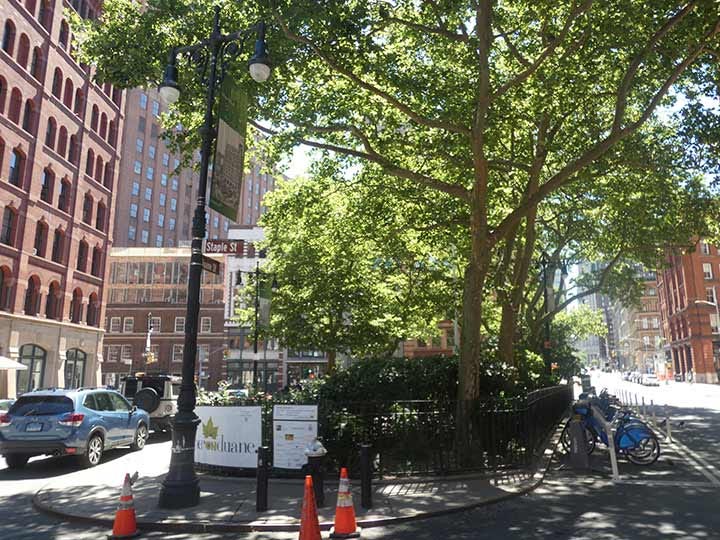
When I am here I always check on Duane Park at Hudson and Duane to see how it’s doing. Duane Street splits in two in Tribeca, with one half ending at Hudson Street and the other half continuing east into the Foley Square area. Between the two halves, you’ll find Duane Park, a spot that has been green since the very beginnings of New York City. It was originally part of a Dutch farm dating to the mid-1600s that later was owned by the Duke of York of England, who gave it to Trinity Church, which owned vast amounts of property in lower Manhattan. The church sold it to New York City for the grand total of five dollars in 1797. Since the park predates lower Manhattan’s street grid, Duane Street was purposely divided to get around it when it was cut through in the early 1800s.
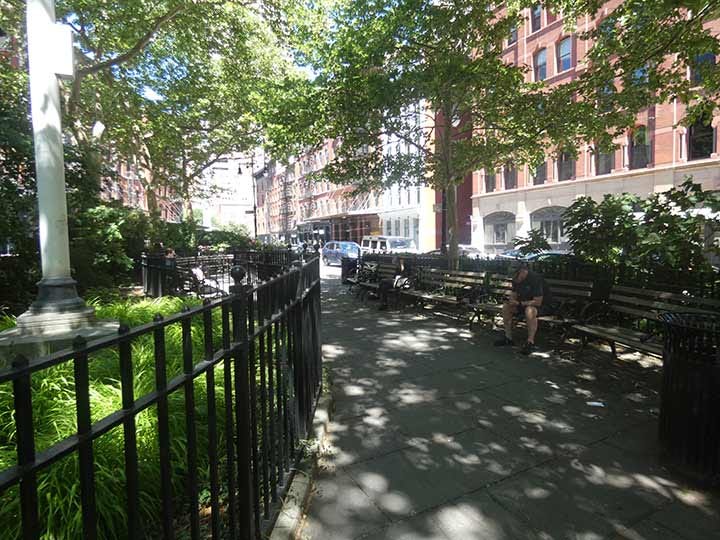
For such a tiny park--it’s only .115 acre in size--Duane Park has had several redesigns over the years. In 1870 it was given trees, a lawn, shrubs, bluestone curbs, and a new iron fence. In 1887, Parks Commissioner Samuel Parsons Jr. and Calvert Vaux, who had co-designed the much vaster Prospect and Central Parks with Frederick Olmsted, designed a new plan featuring pedestrian paths. In 1940 there was yet another plan, featuring more concrete, fewer trees and a new flagpole, and finally, in 1999, Duane Park reversed course, adding more plants and returning to Parsons’ and Vaux’s plan, while keeping the flagpole.
Kevin Walsh is the webmaster of the award-winning website Forgotten NY, and the author of the books Forgotten New York (HarperCollins, 2006) and also, with the Greater Astoria Historical Society, Forgotten Queens (Arcadia, 2013)